
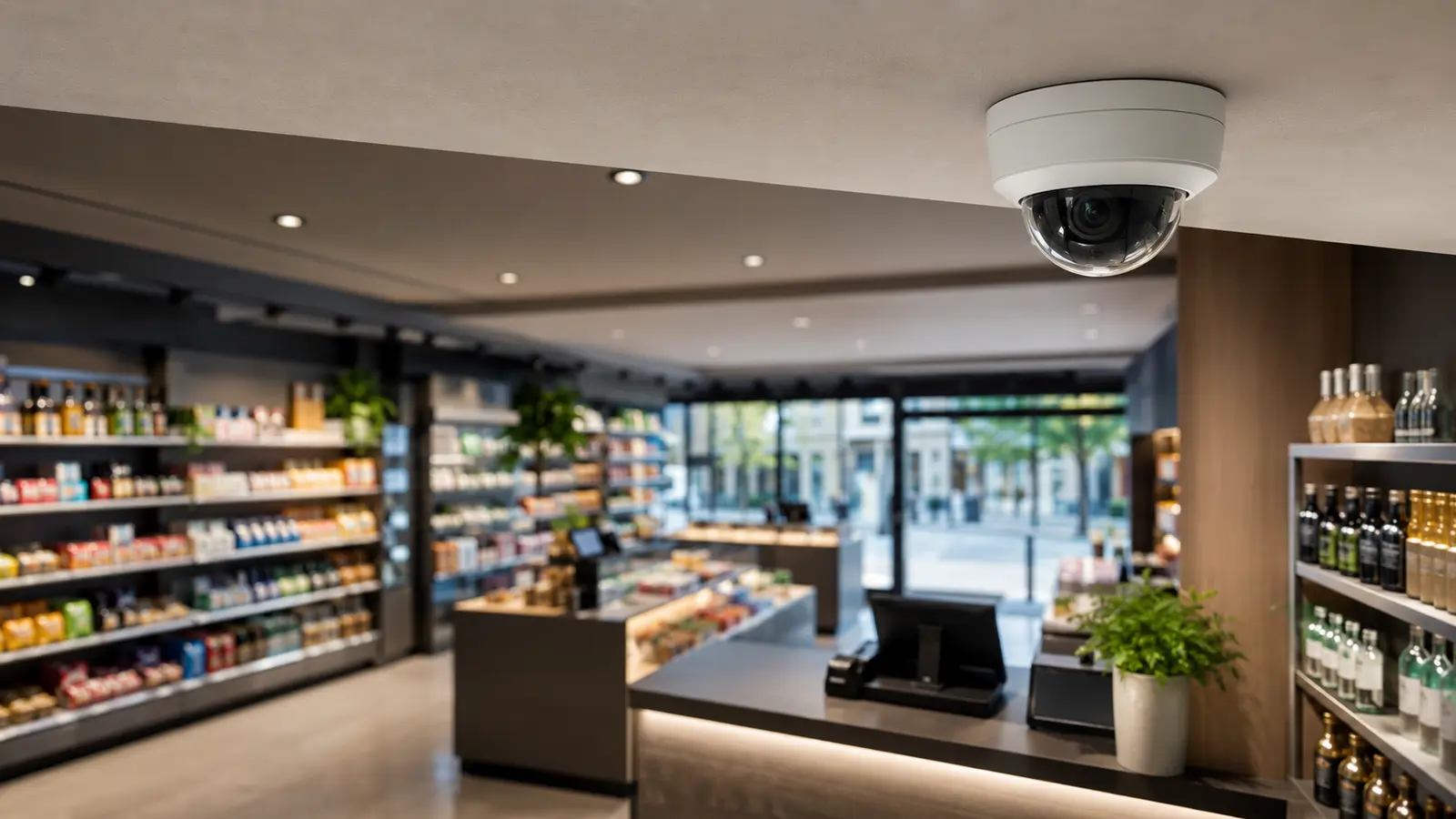
Burglary, theft, vandalism or conflicts in the cash register area can have significant consequences for shops.A professionally planned video system can deter, document situations in a comprehensible manner and give those responsible a better overview.However, cameras must not simply be installed as comprehensively as possible.
In Germany, video surveillance regularly processes personal data.Therefore, the purpose, necessity, balancing of interests, field of view, storage period, access and information of the data subjects must be clarified before assembly.This article provides a practical orientation, but does not replace legal individual counseling.
Briefly summarized
- ✓Every camera needs a concretely defined and traceable purpose.
- ✓Only the area that is actually necessary for this purpose should be covered.
- ✓Instructions must be recognizable before entering the monitored area.
- ✓Storage and access rights should be made as short or as narrow as possible.
Start with the protection target, not with the number of cameras
Good planning starts with concrete risks: is it about the entrance area outside the opening hours, a particularly vulnerable area of goods, the cash register or a remote warehouse access?For each risk, it is checked whether organizational or mechanical measures are sufficient and what additional benefits a camera offers.
A blanket justification such as general safety is too inaccurate.The purpose determines later field of view, recording time, storage time and access authorization.If the purpose changes, the evaluation must be resumed.
Legal basis and balancing of interests
§ 4 BDSG mentions for publicly accessible rooms, among other things, the exercise of domestic law and legitimate interests for specifically defined purposes.At the same time, the interests of the persons concerned worthy of protection must not prevail.In addition, the requirements of the General Data Protection Regulation must be observed.
In practice, this means that the company documents the real interest, which is why monitoring is appropriate and necessary, and why milder measures are not sufficient.Areas with high personal expectation of confidentiality are particularly sensitive.Toilets, changing rooms or comparable rooms are taboo.Permanent control of employees is also particularly problematic legally.
Choose camera positions in a data-saving way
The field of view should hit the protection target, not as much area as possible.Public walkways, neighboring plots, housing or unnecessary workplaces do not belong in the admission.Modern systems allow private zones with which areas can be permanently masked.
A higher resolution is not automatically better.For the planning, it must be clarified what should be recognizable in an emergency: a situation, a person in the defined area or a license plate at a controlled driveway.Lighting, backlight, mounting height and focal length are often more important than the highest number of megapixels.
- Enters and endangered transitions in a targeted manner instead of comprehensively
- Excluding or physically avoiding public and foreign areas
- Plan the cash register area to avoid unnecessary employee monitoring
- Test night vision and lighting in real conditions
- In principle, evaluate audio recording separately and usually deactivate it
Recording, live image or event detection?
Not every protection target requires permanent recording.Depending on the situation, a live image, a timed recording outside of opening hours or a movement-based event detection may be sufficient.The less data is processed, the lower the risk and administrative burden.
With intelligent detection, it is necessary to check exactly what the system analyzes.Simple motion detection is something other than biometric detection or automated behavioral analysis.Functions should not be activated just because the camera offers them technically.
Limit storage time and access
Recordings may not be collected indefinitely as a precaution.The storage period must fit the purpose and be checked regularly.If a specific incident occurs, relevant sequences can be secured and treated separately for further processing.Without an event, the system should automatically delete or overwrite data.
Only fixed people get access.Accounts should be set up individually, with strong passwords and, if possible, additional protection.Each remote access increases the attack surface.Standard passwords, unnecessary cloud shares and openly accessible recorders are avoidable risks.
Sign and transparent information
Those affected must be able to detect the monitoring before entering the captured area.The European guidelines provide for a first level of information on the sign and further mandatory information at a second level.The sign should therefore not hang behind the camera or first on the cash register.
Clean documentation includes, among other things, controller, purpose, legal basis, legitimate interests, storage period, recipients, data subject rights and an accessible source of information.Which information is required in the specific case should be examined in a technical manner.
Treat employee areas particularly carefully
Employees often cannot escape the camera during their work.As a result, the procedure weighs particularly heavy.Concealed or durable performance control is not a normal application of a security system.The Berlin Data Protection Authority has already pointed to inadmissible hidden surveillance at the workplace and corresponding sanctions.
Before installations in areas with employees, the purpose, alternatives, operating procedures and labour law requirements should be examined separately.If there is a works council, co-determination rights can be relevant.
Technical security is part of data protection
A camera only protects the business if the system itself is protected.Recorders and network devices belong in a controlled area.Firmware, user accounts and recovery routes must be maintained.Access from the outside should be via a secure connection and not via insecure port shares.
For companies, a separation from the normal guest or office Wi-Fi makes sense.Equally important are an uninterruptible power supply for critical components, regular functional tests and documented competence.A switched-off recorder, a wrong time or a covert lens often only stand out after an incident.
The practical checklist before installation
Before cables are laid or cameras are ordered, those responsible should answer the following points in writing.In the event of uncertainty, a data protection examination of the specific project is recommended.
- What specific incident or risk should be reduced?
- What milder measures have been considered?
- What exact image section is required?
- When is it viewed live, when is it recorded and when deleted?
- Who is allowed to access and how is the access secured?
- How are customers, visitors and employees informed?
- Who regularly checks function, purpose and configuration?
Camera or alarm system: connect different tasks in a meaningful way
A camera documents or allows visual inspection, but does not automatically prevent the entry of an object.An alarm system detects defined events via opening, motion or other sensors and can immediately report or trigger a siren.Both systems therefore fulfil different tasks.
In a coordinated concept, the alarm system reports an event and the camera then helps with verification.This does not require every movement to be permanently recorded.It is important to clearly separate the accesses, user roles and notifications.A system should work in an understandable manner even if the person responsible is not on site.
- Camera: vision, documentation and targeted verification
- Alarm system: immediate detection and notification
- Mechanical protection: doors, locks, lighting and regulated keys
- Organizational protection: clear responsibilities and behavior in the event of an event
Commissioning, maintenance and regular effectiveness testing
After assembly, fields of view at day and night, motion detection, time, recording, memory overwriting and remote access should be practically tested.Responsible persons need a short documentation: Who is allowed to access, how is an incident secured, when are accounts revoked and who controls error messages?
The concept must be considered again at least in the case of conversions, changed use or new risks.Cameras can be covered by shelves or decoration, passwords remain active after personnel changes and signs no longer fit the field of view.Regular checks keep technology and data protection at the same level.
Clearly answered
Frequently asked questions
Can I film the walkway in front of my shop?+
In principle, public areas should not be covered without concrete necessity.Camera angles and private zones must be planned in such a way that only the area necessary for the specified purpose is visible.Have the individual case checked.
How long can I save recordings?+
There is no blanket duration suitable for every business.It must be necessary for the specific purpose and as short as possible.The system should automatically delete or overwrite without incident.
Is a camera reference sign enough?+
The sign is important, but does not replace the examination of the admissibility and the further information obligations.It must be recognizable before entering the supervised area.
Can I access the cameras via smartphone?+
Technically yes, but only with secure configuration, individual accounts and strictly limited permissions.Unnecessary remote access and standard passwords should be avoided.
Further sources
For technical and legal details, the following primary sources were taken into account:
Personal in Berlin
Safety starts with clean planning.
We plan camera positions, network, recording and secure access to match your business.You can coordinate legal questions with your data protection consultant if necessary.